
Saying the Quiet Part Out Loud About Political Messaging
And my journey to build a solution for it.

Forging A New Path After 2024
Like many people in our country, I have my fair share of frustrations with our political system. At this stage of my career, the optimism and novelty that comes from the adrenaline of campaigns has whittled away, but I am still deeply moved to fix this small corner of the world in my own way.
In my experience, I’ve noticed that decision makers in this industry rarely live like the people they are trying to reach. This disconnect between political operatives and voters extends beyond representation in politics. Even if there are farmers and single mothers working on campaigns, their voices and experiences aren’t powerful enough to influence the messaging on a hundred thousand dollar tv ad. Existing solutions, like polling and surveys, try to understand various voting blocs and are thorough at capturing a snapshot of what people think.
But the underlying problem of political messaging is overlooking and misunderstanding the why behind what people say.
After the 2024 presidential campaign, I took some time to think about the most realistic way to build connections with voters beyond grouping them by worn out demographics. I looked at how other industries build trust with their audience, such as using AI technology to uncover patterns in large volumes of customer feedback. How can I apply this approach to bridge the gap between political messaging assumptions and what matters most to people?
I built OliveWing as a solution to better understand the meaning behind what is being said. Using AI natural language processing, OliveWing is able to measure how much a message might resonate with an audience. Additionally, the tool surfaces the reason for the score through content analysis and tracking consistent themes and emotional drivers. This results in more effective messaging which saves teams time and money. But perhaps most importantly, OliveWing highlights the intention behind language to build deeper and more meaningful connections.
Testing OliveWing in the Real World
My vision of OliveWing as a solution is informed by my experience across marketing agencies, AI tech startups, and campaigns. On the national campaigns, I had roles that exposed me to strategic planning and spending decisions for digital messaging. There were endless tools, vendors, and consultants available to advise on messaging. So when I started focusing on local level politics in New York City, I noticed how few resources were accessible for down-ballot races, when messaging can make or break a campaign.
This is especially apparent given the results of the NYC mayoral primary in June. In an early test with OliveWing, we compared how two broad audiences – millennial women and listeners of The Joe Rogan Experience – responded to messages on affordable housing from Zohran Mamdani’s campaign. The contrast of the resonance score between the groups was striking, but the most valuable takeaway was why specific wording worked better.
To elaborate, under Mamdani’s platform on affordable housing, he proposes:
freezing rent
ending deed theft
Using OliveWing, the millennial women persona scored around 8 out of 10 on both messages. However, for the Rogan listener persona, “freezing the rent” scored 3.5, whereas “ending deed theft” saw the score jump to 6.75.
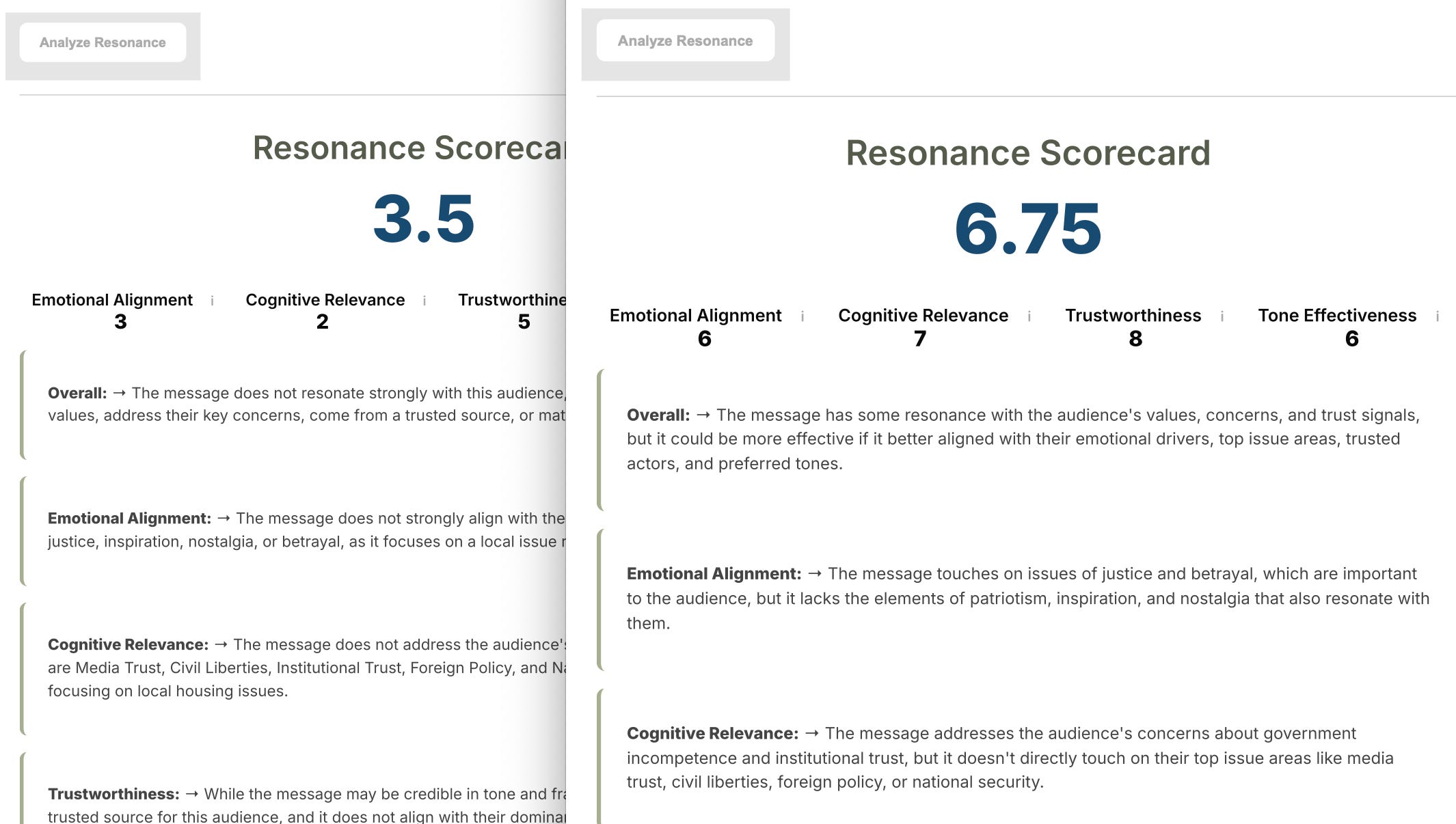
OliveWing uncovers the why. There are four dimensions that make up the total resonance score: emotional alignment, cognitive relevance, trustworthiness, and tone effectiveness. Looking at just one of the dimensions, cognitive relevance, “deed theft” uses language that insinuates government incompetence and institutional distrust among Rogan audience personas. Whereas the connotation of “freezing the rent” doesn’t address key concerns for that same group.
In this example, OliveWing validated much of what we’ve now seen from political experts in the post-election coverage. While aspects of this test may be apparent for experienced political communications strategists, many local races don’t have the ability to hire these experts.
Providing this messaging platform to smaller campaigns could extend periods between intermittent polling, improve digital communications, and enhance survey results – all leading to consequential savings.
I’ll save the full results for a future post, but what this test showed me is that OliveWing can uncover gaps in understanding people before campaigns spend millions amplifying the wrong message to the wrong audience.
While the Democratic Party looks inward after losing up and down the ballot in 2024, we need to develop more innovative solutions to understand voters. Consumer-grade AI tools are becoming more widespread and sophisticated, the adoption is inevitable. It is imperative to acknowledge and mitigate the negative impacts of AI while building towards the future we want to see. This is the moment to invest in transformative ideas.
Learning How to Be a Tech Founder
I started OliveWing in April 2025. I spent several weeks in the spring conducting user interviews with former co-workers, acquaintances, and other practitioners in the space who have been generous with their time and opinions.
Across these conversations, the overarching feeling was that political messaging didn’t resonate with voters. There wasn’t one specific solution that stood out – every organizer, email strategist, or fundraiser had a vision of what can be improved. But in everyone’s responses, there was a clear desire to try new approaches.
The past few months have been some of the most challenging and fulfilling of my career so far. The process of building tech can be isolating for any solo founder in a niche industry, and especially so for an extrovert like myself. Most of my days are spent vibe-coding, managing business operations, and securing meetings. However, there are moments that I think would be helpful to share with fellow entrepreneurs, political nerds, and anyone interested in what I have to say.
My intention with this Substack is to document the process and share my experience building OliveWing. You can expect to see posts with insights surfaced from the product and a behind-the-scenes peek at building political tech. I also plan to occasionally comment on my experience building an AI tool and reflecting on the integration of AI into politics.
Follow along if you’re interested in my journey! If you’d like early access or to learn more about how to use OliveWing, reach out to me at hello@olivewing.co or visit olivewing.co.
Welcome! It’s great to see you here, Amanda! This was an eye-opening read. I love to see solutions being made and dots being connected. Looking forward to reading more of your posts and seeing how OliveWing helps shape the messaging going forward. 💙